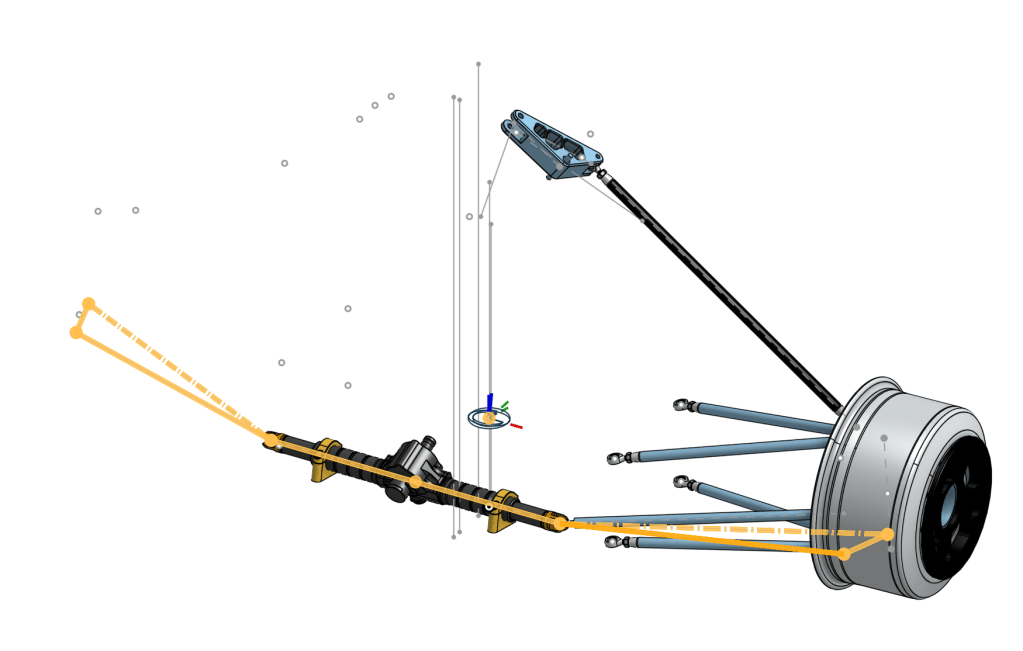
As part of Tufts Electric Racing, one of my jobs on the team has been designing the steering system for our 2026-2027 vehicle. For financial reasons, our team is keeping last year’s steering rack. My job is to design the rest of the steering geometry around it, using the rack’s specs, the suspension design, chassis restrictions, and driver preferances.
Ackermann describes how the inner and outer front wheels turn at different angles through a corner. Ackermann percentage compares the geometry you’ve built to the ideal case, where every wheel traces a circle around the same center point. It’s one of the most important parameters in a steering design. I started with a rough layout and tuned it in a custom MATLAB calculator that computes Ackermann percentage for different geometries.
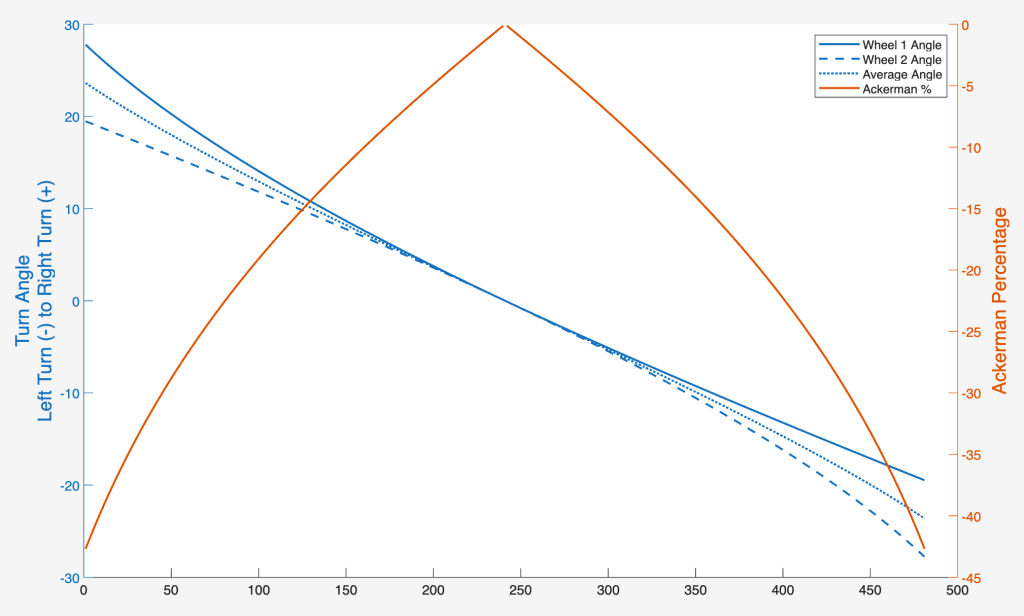
The suspension leads and I chose 40% anti-Ackermann at the maximum turn angle (about 32°). It’s meant to improve high-speed cornering for autocross. I picked 40% after looking at what other teams ran. It’s large enough that we should feel a difference when driving, but still moderate so that the driver does not need a lot of practice to be able to drive the car well.
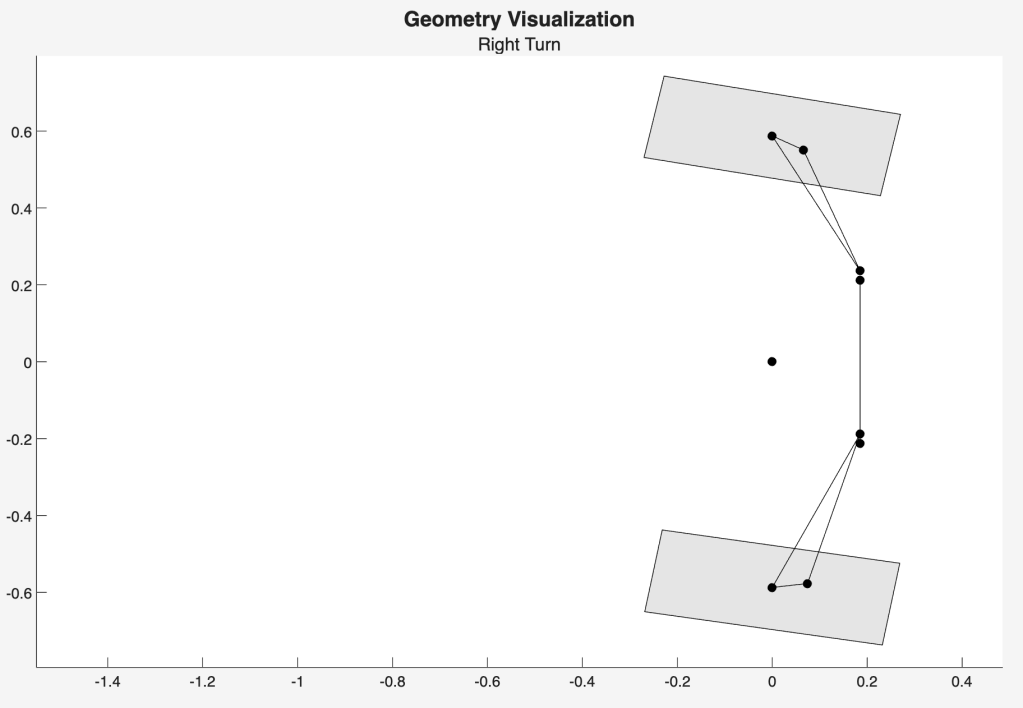
Another goal was keeping the rack close to the centerline of the wheels to reduce the force the driver needs to turn them. Our previous vehicle was very difficult to steer since the distance between the rack and wheel centerline was so large. My design reduces this distance to about 2/3 of the previous size, which should produce a reasonable steering force. To achieve this, there is a double U-joint steering shaft to span the bend between the rack and the steering wheel.
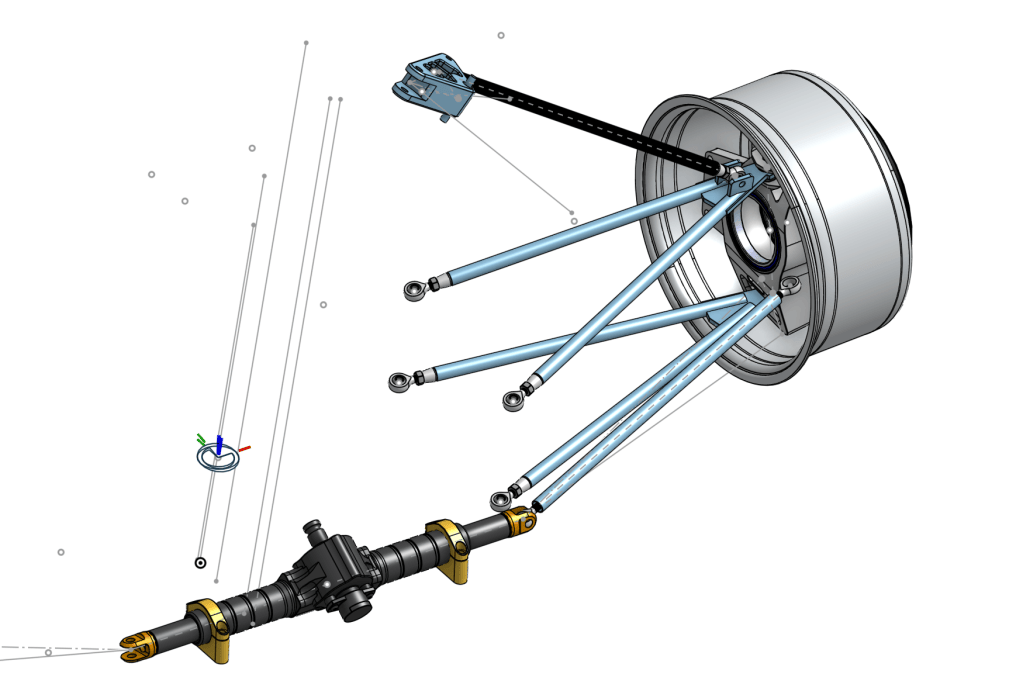
Final designing, fabrication, and testing are upcoming, set to be completed by the Spring 2027 FH+E competition.

